Food Image Classification and Recommendation Menu
Building a food ingredient classification model for smarter nutrition recommendations.
AI Engineer and Project Manager
Team
Machine Learning
4 Months
Overview
Food Ingredient Classification Model is the core component of the GiziMeal project, responsible for identifying food ingredients from user-uploaded images. The model is developed using a Deep Learning approach to recognize 15 food ingredient categories, providing predictions that serve as the foundation for nutritional analysis and balanced meal recommendations within GiziMeal. The development process covers the complete machine learning pipeline, including dataset preparation, image preprocessing, model training, and performance evaluation to ensure accurate and reliable classification.
Problem Background
- Food Ingredient Identification Is Still Manual: Identifying food ingredients from images often requires manual observation, which is time-consuming and prone to errors.
- Variations in Food Appearance: Differences in lighting, viewing angles, and ingredient appearance make image classification more challenging.
- Reliable Predictions Are Essential: Nutritional analysis and meal recommendations depend on accurate classification results, requiring a reliable prediction model.
Solution Approach
- Deep Learning-Based Classification Model: Develops an image classification model capable of automatically recognizing various food ingredients from uploaded images.
- Improved Dataset Quality: Applies preprocessing and image augmentation techniques to improve the model's ability to recognize diverse image conditions.
- Model Performance Evaluation: Evaluates the model using unseen test data to ensure strong generalization and reliable predictions.
- Integration with GiziMeal: Connects prediction results with GiziMeal's nutrition recommendation system to automatically generate nutritional information and balanced meal recommendations.
System Workflow
- 1
Food ingredient images are collected and prepared.
- 2
Images are preprocessed and augmented to improve data quality.
- 3
The dataset is divided into training, validation, and testing sets.
- 4
The model is trained to learn patterns for each food ingredient category.
- 5
The model is evaluated using the testing dataset.
- 6
Prediction results are integrated into the GiziMeal application to support nutrition analysis and meal recommendations.
Key Features
Food Ingredient Classification
01Automatically identifies 15 food ingredient categories from digital images using a Deep Learning model.
Data Preprocessing and Augmentation
02Performs image preprocessing, normalization, and data augmentation to improve training data quality.
Model Training and Evaluation
03Trains the classification model and evaluates its performance using appropriate evaluation metrics.
New Image Prediction
04Classifies unseen food ingredient images with trained model predictions.
GiziMeal Integration
05Generates predictions that serve as the basis for nutritional analysis and balanced meal recommendations in GiziMeal.
Tech Stack
Project Team






Project Gallery
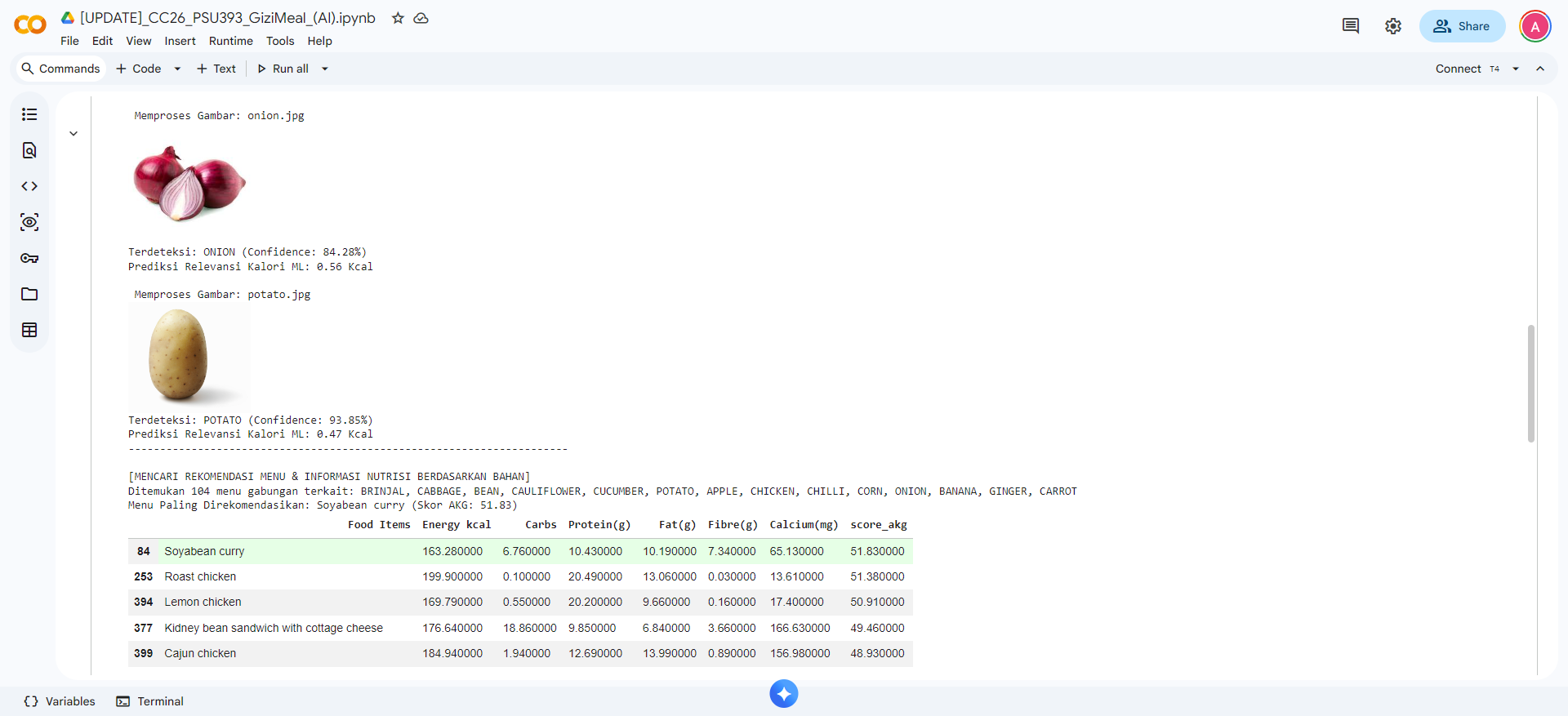
AI Model Stats Dashboard
Detailed look at CNN validation curves and multi-task predictions.
OTHER PROJECTS


Let's Build Something Together
Reach out if you want to chat about product engineering opportunities, full-time positions, or custom architectural consulting.