Bitcoin Price Forecasting
Forecast Bitcoin price movements based on historical data.
Data Scientist
Personal
Machine Learning
1 Months
Overview
Bitcoin Price Forecasting is a time-series prediction project focused on forecasting Bitcoin closing prices using historical data. The project compares two Recurrent Neural Network approaches, namely a Baseline LSTM model and a Seq2Seq LSTM with Attention Mechanism. Using 96 historical time steps to predict the next 3 steps ahead, the project covers the full workflow from feature engineering, data scaling, and window-based dataset creation to model training and comparative evaluation.
Problem Background
- Bitcoin Prices Are Difficult to Predict Manually: Bitcoin price movements are highly volatile, making them difficult to analyze visually without a more systematic modeling approach.
- Historical Patterns Are Highly Complex: Bitcoin price data is influenced by many factors and often changes its pattern over time, requiring models that can learn long-term dependencies.
- Multi-Step Forecasting Is More Challenging: Predicting multiple steps ahead is significantly harder than one-step forecasting because the model must understand sequential data more deeply.
Solution Approach
- Deep Learning Approach for Time Series: Uses a deep learning-based model so the system can learn Bitcoin price patterns more adaptively.
- Seq2Seq Architecture with Attention: Applies a sequence-to-sequence model with an attention mechanism to improve the stability of multi-step forecasting.
- Feature Engineering and Data Windowing: Builds technical features and organizes the data into historical windows so the model can capture price movement patterns more effectively.
- Comparative Model Evaluation: Compares the performance of the baseline model and the main model to identify the most effective forecasting approach.
System Workflow
- 1
Historical Bitcoin price data is loaded into the system.
- 2
The data is cleaned and analyzed to understand initial patterns.
- 3
Technical and statistical features are created from the historical data.
- 4
The dataset is split into train, validation, and test sets chronologically.
- 5
The data is transformed into a windowed format for multi-step forecasting.
- 6
Both the Baseline LSTM and Seq2Seq LSTM models are trained and evaluated.
- 7
Predictions are compared with actual values and visualized.
Key Features
Time-Series Feature Engineering
01Builds technical and statistical features from historical Bitcoin price data to help the model better learn price movement patterns.
Separate Data Scaling
02Applies different scaling strategies for features and target values to stabilize the data distribution during training.
Multi-Step Windowing
03Creates window-based datasets so the model can learn from past sequences and predict multiple future steps.
Seq2Seq LSTM with Attention
04Uses a sequence-to-sequence architecture with an attention mechanism to improve multi-step time-series forecasting performance.
Evaluation and Result Visualization
05Provides performance comparisons between the baseline model, Seq2Seq model, and actual Bitcoin prices through evaluation metrics and visual plots.
Tech Stack
Project Gallery
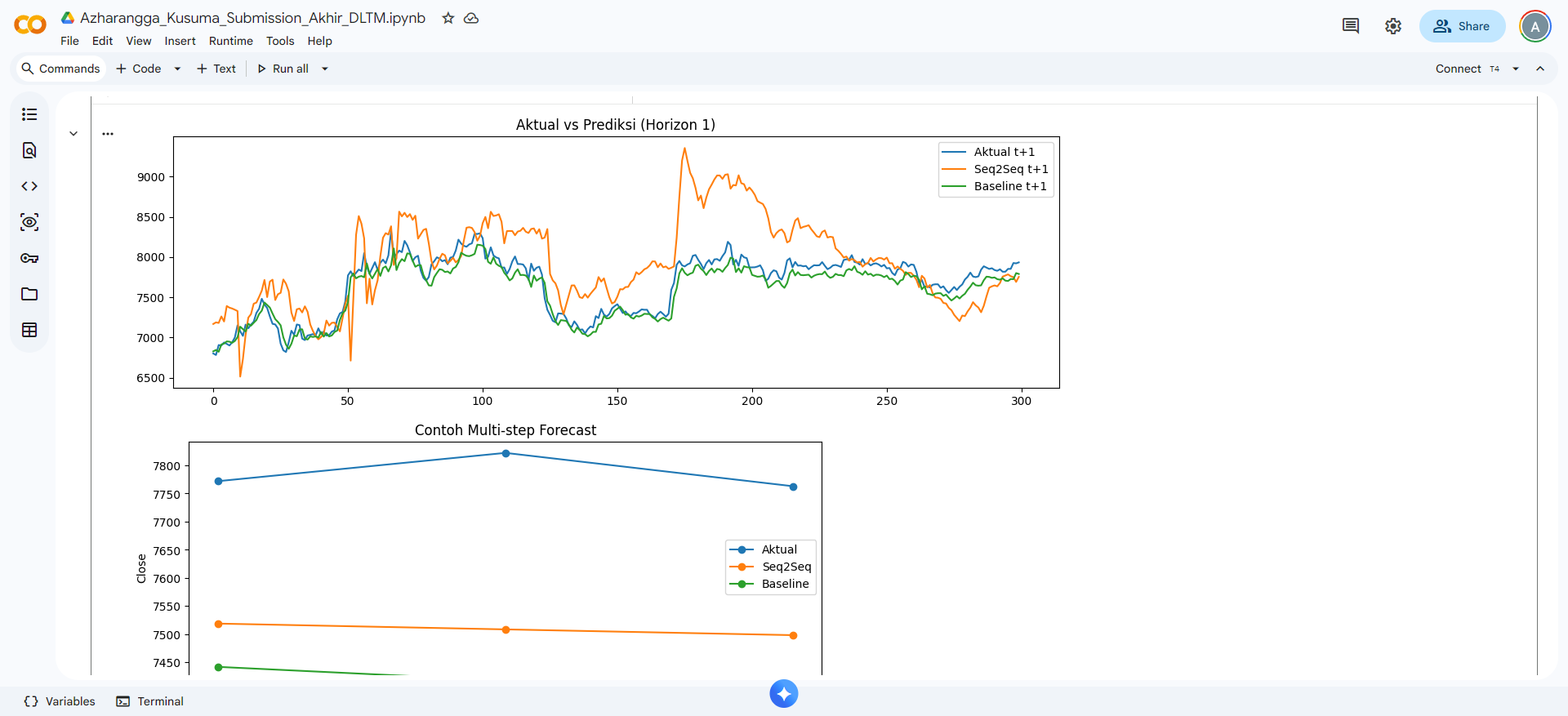
Price Prediction Evaluation Plot
Comparative plot of Seq2Seq LSTM model predictions vs actual Bitcoin prices.
OTHER PROJECTS


Let's Build Something Together
Reach out if you want to chat about product engineering opportunities, full-time positions, or custom architectural consulting.